One of my longtime clients owns a commercial tire shop. His Android smartphone had been intermittently failing to charge for several months. Eventually, the phone refused to power on altogether.
To be fair, my client got every bit of value out of that device. Technology experiences wear and tear, and this smartphone finally decided it was done. Like a good steak, it was cooked.
The customer called me urgently.
“Duke, will you help us?”
The husband and wife asked me to accompany them to the Verizon store first thing the next morning. We arrived early and had breakfast at the local Chick-fil-A in the same shopping center while waiting for the store to open.
When Verizon opened its doors, we walked in and began the process of selecting replacement phones.
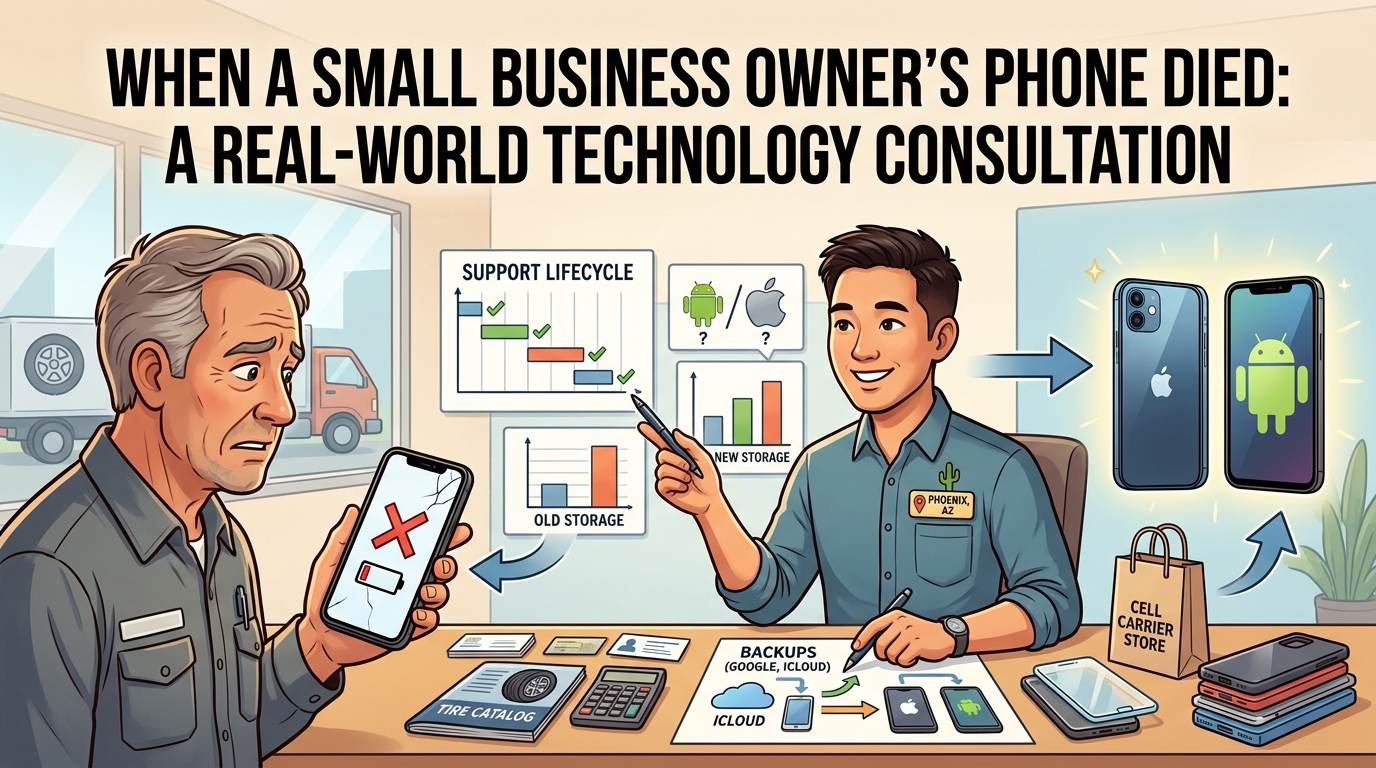
The husband had used Samsung Android phones for years. He asked me whether he should stay with Android or switch to an iPhone.
I explained that staying with Android would allow him to continue using a familiar operating system without having to learn a new interface. However, if he switched to an iPhone, his wife and daughter already used Apple products and could help him whenever he got stuck.
I also explained that there would be a learning curve.
“Apple products are designed for people who just want the device to work. They typically have fewer customization options than Android, but many people appreciate their simplicity.”
One thing I told the husband made him laugh.
“You’ll probably call me less after you switch to the iPhone.”
There was some truth behind the joke. In my experience, Apple tightly controls both the hardware and software, which often results in a simpler, more predictable experience for many users. Android devices generally offer greater flexibility and customization, but that flexibility can sometimes introduce additional complexity.
Neither platform is right or wrong. It depends on the user.
In this case, the customer’s Android phone had already died, creating stress and disrupting business operations. He relied on that phone to communicate with customers, suppliers, and employees. The inconvenience and lost productivity had already reached what I call the angst factor.
The angst factor occurs when the cost of frustration exceeds the cost of the solution.
At that point, the conversation is no longer about saving money. It becomes about restoring productivity and reducing stress.
Next, we discussed whether he should purchase Apple’s newest model or save money by purchasing the previous year’s model.
I explained that every technology product has a support lifecycle attached to it. Manufacturers release operating system updates, security patches, and feature updates for a limited number of years. When a customer buys a device, they enter somewhere within that support lifecycle.
The newer the device, the longer the remaining support window. The tradeoff is that newer devices usually cost more.
The older the device, the lower the cost. However, part of the support lifecycle has already been consumed.
The husband wasn’t the only person upgrading that morning. His wife was still using an older iPhone that did not support 5G and was operating on 4G LTE. She was also running out of storage because she takes a tremendous number of photos and frequently downloads music to her phone.
When recommending smartphones, I generally suggest purchasing at least twice the amount of storage currently being used. Most people don’t take fewer photos, install fewer apps, or save less data over time. Their storage needs tend to grow.
Buying additional storage upfront is usually much less expensive and much less frustrating than running out of space a year or two later and being forced to upgrade sooner than expected.
Planning for tomorrow is just as important as meeting today’s requirements.
As we reviewed their options, it became clear that both devices had reached the point where replacement made sense.
After evaluating promotions, trade-in offers, storage options, and pricing, the customers determined that last year’s iPhone model provided the best value. They saved a considerable amount of money while still receiving many years of software updates, security support, and modern hardware features.
The day before our Verizon visit, I helped the customer contact his current mobile carrier to obtain the account number and port-out PIN required to transfer his number. We arrived at the Verizon store with everything ready to go.
Cell phone sales representatives love it when I walk in with my clients.
The decisions have already been discussed. The necessary information is available. The questions have already been answered. The process becomes faster and easier for both the customer and the salesperson.
The Verizon representative asked whether they wanted accessories such as a case and screen protector. Although they could have purchased those items elsewhere for less money, they chose convenience.
They wanted to get their phones operational, get back to work, and return customer calls.
The customers paid me for my time and consultation.
Because their information had already been backed up through Google and iCloud, the transition was smooth. Their contacts, calendars, email, photos, and other important information were restored to the new devices without issue.
This experience highlights an important lesson for small business owners.
When a critical piece of technology fails, even something as common as a smartphone can disrupt operations. Every hour without communication represents potential lost customers, missed opportunities, and lost revenue.
The real cost is rarely the device itself.
The real cost is the interruption.
Having an experienced, trusted technology consultant available to help guide a stressful situation reduces confusion, eliminates unnecessary delays, and helps businesses make practical decisions under pressure.
Technology failures are stressful enough.
You don’t need to navigate them alone.
About Duke Nguyen
Duke Nguyen is a technology consultant serving Phoenix, Arizona. Duke helps homeowners, retirees, churches, and small business owners make informed technology decisions involving computers, smartphones, cybersecurity, cloud services, backups, websites, Microsoft 365, Google Workspace, and networking.
With an education-first approach, Duke believes technology should simplify life and business, not complicate it. Whether helping a customer recover from a cybersecurity incident, select the right computer, replace a failed smartphone, or migrate data to a new device, Duke focuses on practical solutions that provide long-term value.
Many of Duke’s articles are inspired by real customer experiences and real-world technology challenges. His goal is to help others avoid costly mistakes and make better technology decisions before problems occur.
Need help with computers, smartphones, cybersecurity, cloud services, websites, backups, or small business technology? Contact Duke Nguyen to schedule a consultation.