I worked at a customer service call center. Every day, I received calls from customers who needed to replace their checking account information or debit card because their account had been compromised.
Many told me it would take days or weeks for the bank to issue a new debit card or checking account number. During that time, they struggled to pay bills and manage recurring payments.
Most of these customers were seniors who believed in avoiding debt and did not use credit cards. Instead, they relied on ACH payments and debit cards. That worked well until their accounts were compromised.
What surprised me was that many of the same customers experienced the problem more than once.
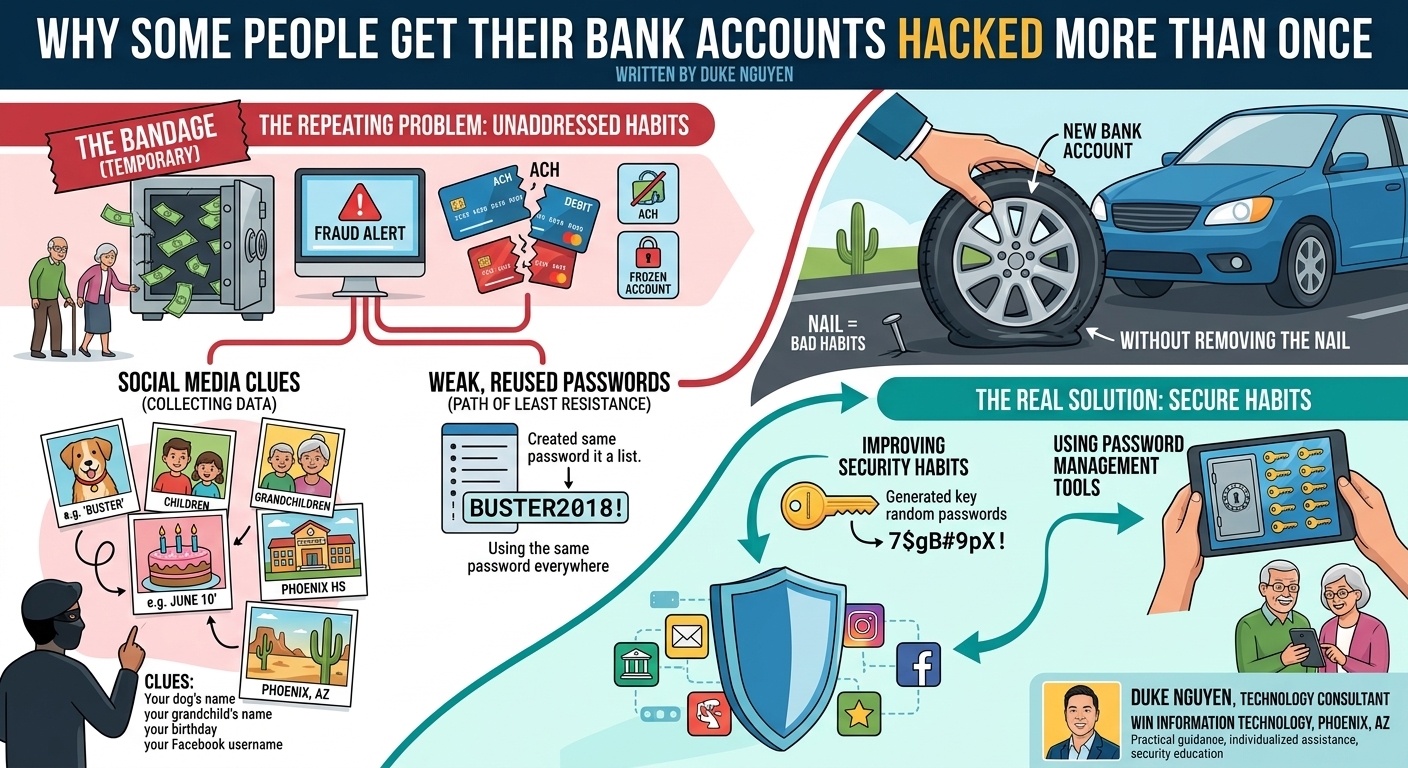
The new bank account was only a temporary bandage. The real issue was never addressed.
People are creatures of habit. Most choose the path of least resistance when creating passwords.
When asked to create a password, many think:
“What’s a word long enough to meet the requirement?”
So they choose:
- A pet’s name
- A child’s name
- A grandchild’s name
- The street where they grew up
- A favorite sports team
Then they add a birth year, graduation year, and an exclamation point.
For years, this seemed harmless.
Then social media arrived.
People began sharing photos of pets, children, grandchildren, vacations, favorite movies, schools attended, birthdays, anniversaries, and family history.
What many people don’t realize is that every public detail creates another clue.
Somewhere in the world, someone may be collecting those clues.
They see:
- Your dog’s name
- Your grandchild’s name
- Your high school
- Your birthday
- Your hometown
- Your Facebook username
If you use the same password across dozens of websites, they don’t need to guess dozens of passwords.
They only need to guess one.
Many people assume:
“It has never happened to me, so it probably won’t.”
Until they wake up to a fraud alert.
Until their bank account is frozen.
Until bills cannot be paid.
Until the bank begins an investigation that may take days or weeks to resolve.
Then a new account is created.
A new debit card is issued.
And life continues.
But if the underlying habits never change, the problem remains.
The bank account was never the weakness.
The password was.
More importantly, the habit was.
Replacing a bank account without improving security habits is like replacing a flat tire without removing the nail from the road.
Sooner or later, the problem returns.
About Duke
Duke Nguyen is a technology consultant serving Phoenix, Arizona. Many of Duke’s articles are based on real-world customer experiences and are designed to help readers avoid costly mistakes through education, practical solutions, and common-sense technology guidance.
Duke helps clients improve their online security by creating unique, randomly generated passwords and using password management tools to securely store them. The goal is simple: stop reusing passwords, reduce risk, and make technology easier to live with.
If you’re concerned about online security, password management, account protection, or securing your digital life, call Duke Nguyen at Win Information Technology for practical guidance and personalized assistance.